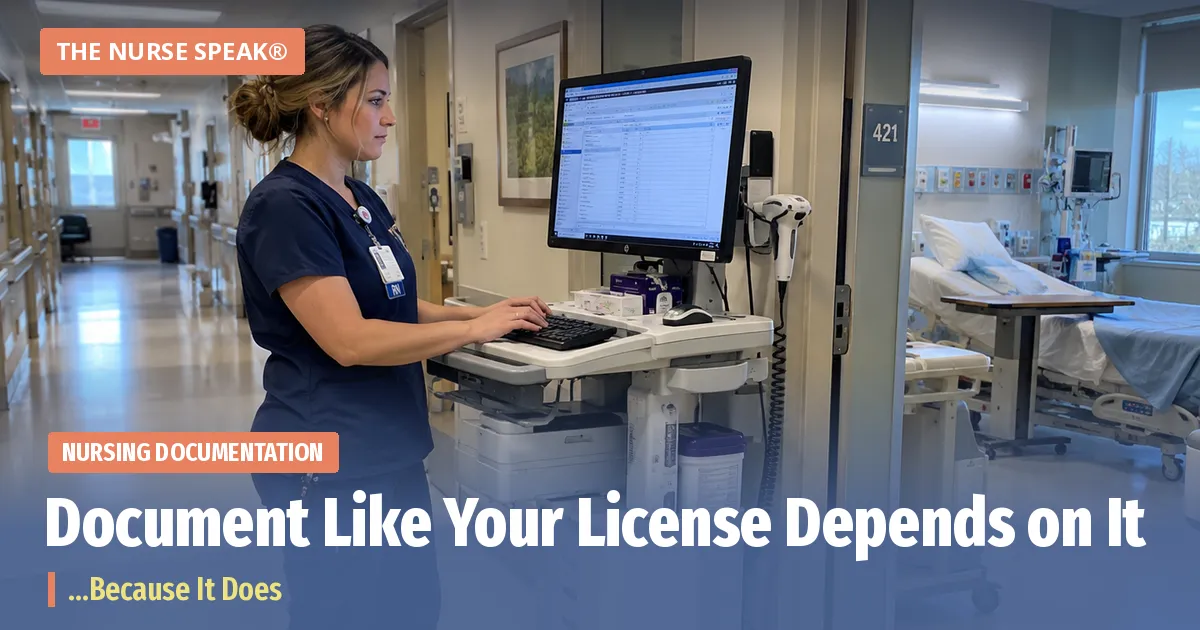
Nursing Documentation: Document Like Your License Depends on It... Because it Does!
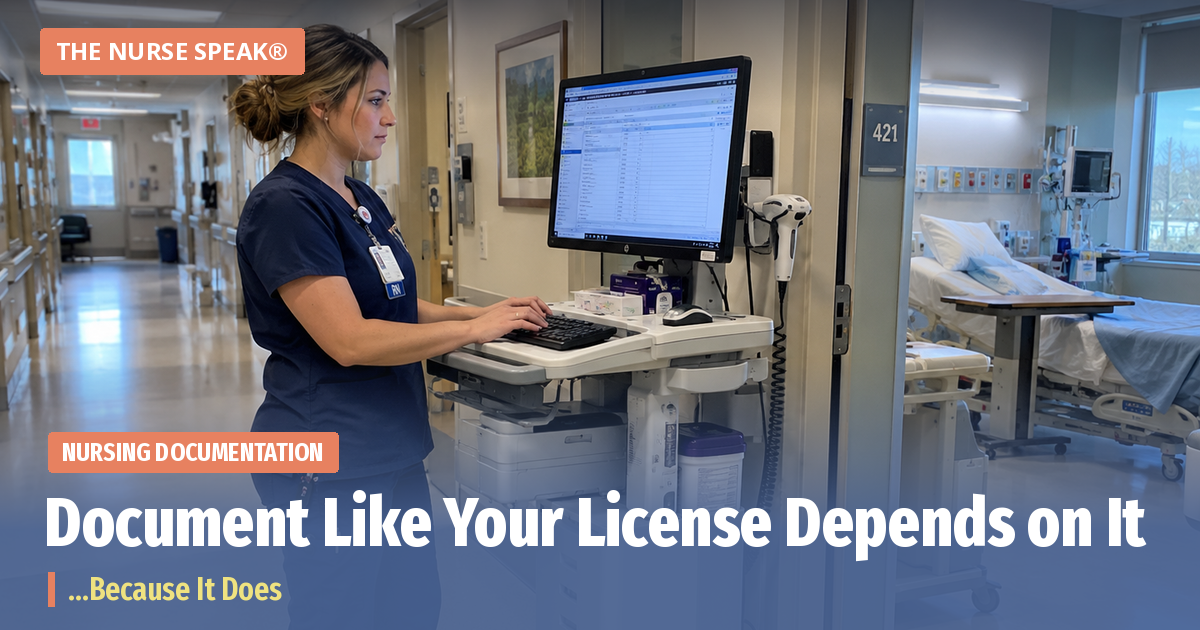
Let's talk about something EVERY nurse does on every single shift... and something far too many nurses treat as an afterthought. Documentation.
Your documentation is your professional voice when you're not there to explain what you did or what you observed with your patients and residents. It's your legal protection. It's your communication tool. And it's your evidence of quality care.
When something goes wrong—a fall, a medication error, a sudden change in condition—nobody is going to ask you what you remember. They're going to read what you WROTE. This guide will help you document in a way that protects your license, supports your practice, and keeps you out of legal and administrative trouble... all while giving the interdisciplinary team a complete record they can rely on for ongoing care.
"If you didn't document it, you didn't do it."
The Core Documentation Do's
1. DO Document in Real Time—or as Close to the Event as Possible
Why: Memory fades quickly, and details get lost. In legal proceedings, the timestamp on your documentation matters. Late entries raise questions about accuracy and can suggest after-the-fact alterations.
Strategy: Chart as you go, even if it's just quick notes you'll expand on later. When a late entry can't be avoided, label it as a late entry per your facility's policy.
2. DO Use Clear, Concise, Professional Language
Why: Your documentation may be read by attorneys, judges, expert witnesses, and regulators who aren't clinicians. Clarity prevents misinterpretation.
Strategy: Write as if you're explaining to someone outside of healthcare. Avoid slang, unapproved abbreviations, and vague terms.
3. DO Use Approved Abbreviations Only
Why: The Joint Commission keeps a "Do Not Use" list for a reason—abbreviations cause medication errors and misinterpretation. Using unapproved abbreviations can become a disciplinary issue.
Strategy: When in doubt, spell it out. Know your facility's approved abbreviation list.
4. DO Document Objective Observations and Measurable Data
Why: Objective data is defensible. "Patient is agitated" is subjective. "Patient yelling, throwing objects, HR 120" is objective—and it paints a clear picture.
Strategy: Use the camera test. What would a camera see and hear?
5. DO Quote the Patient's Exact Words When Relevant
Why: Direct quotes provide context, show mental status, and are hard to dispute. They're especially critical for refusals, altered mental status, and concerning statements.
Strategy: Use quotation marks for pain descriptions, refusals, threats to self or others, confused statements, and significant concerns.
6. DO Document Patient Education AND the Patient's Response
Why: "Failure to educate" is a common claim. You have to show not only that you taught, but that the patient understood. Their response shows comprehension—or flags that more teaching is needed.
Strategy: Document what you taught, how you taught it (verbal, written, demonstration), and the patient's teach-back or verbalized understanding.
7. DO Document ALL Nursing Interventions
Why: Your interventions show the standard of care was met.
Strategy: Include comfort measures, repositioning, emotional support, and advocacy—not just medications and procedures.
8. DO Document the Patient's Response to Interventions
Why: This shows you're monitoring effectiveness and adjusting care. It demonstrates critical thinking and ongoing assessment.
Strategy: Close the loop. "Morphine 4 mg IV given at 1400 for pain 8/10. At 1430, patient reports pain 3/10, states 'I feel much better now.'"
9. DO Document Any Change in Condition
Why: A change in condition triggers reassessment and possible intervention. Documenting it shows you recognized it and responded appropriately.
Strategy: Include improvement AND deterioration—vital sign changes, behavior changes, pain changes, and more.
10. DO Document All Provider Notifications
Why: This protects you from "failure to notify" claims. You need proof that you escalated your concerns.
Strategy: Document who you called, what time, what you reported, what orders or recommendations you received, and any read-backs you performed.
11. DO Date, Time, and Sign Every Entry With Your Credentials
Why: Timeline reconstruction is critical in legal cases. Your credentials establish your scope of practice and level of training.
Strategy: Sign immediately after each entry. Never leave documentation unsigned.
12. DO Document Refusals of Care, Treatment, or Medications
Why: Patient autonomy is legally protected—but you need proof the patient was informed before refusing. This protects you from "failure to provide care" allegations.
Strategy: Document what was refused, the education provided, the risks explained, and the patient's stated reason. Then notify the provider.
13. DO Use—and Document—the Chain of Command When Safety Is at Risk
Why: If your concerns aren't being addressed, going up the chain shows you advocated for patient safety. Failing to escalate can make you liable.
Strategy: Document each step: reported to the charge nurse at X time, then to the nurse manager at Y time, then to the nursing supervisor at Z time.
"Document as if someone will blame you for NOT doing what you were supposed to do."
Accuracy and Completeness
1. DO Document Complete Assessment Findings—Not Just the Abnormal Ones
Why: Normal findings matter legally, too. They show you performed a complete assessment and can rule out alternative explanations for an adverse outcome.
Strategy: Use your facility's charting system completely. Don't skip sections.
2. DO Be Specific With Measurements, Amounts, and Descriptions
Why: "Large amount" versus "300 mL"... one is vague, and one is evidence. Specificity shows attention to detail and accurate monitoring.
Strategy: Measure output, count items, use rulers and scales, and document exact times.
3. DO Document Pain Using Your Facility's Approved Pain Scale
Why: Pain management is heavily scrutinized. A standardized scale provides objective data and helps track whether your interventions are working.
Strategy: Document the score, location, quality, what makes it better or worse, and your reassessment after every intervention.
4. DO Document Fall Risk Assessments and Interventions
Why: Falls—especially falls with injury—are among the most heavily reviewed and litigated events in healthcare. You must show you assessed the risk and put the right precautions in place.
Strategy: Document the fall risk score, the safety measures in place (bed alarm, non-slip socks, call bell within reach), and the education provided.
5. DO Document Skin Assessments, Pressure Injury Risk, and Existing Wounds
Why: Facility-acquired pressure injuries are closely tracked and frequently litigated. Baseline documentation shows whether an injury was present on admission or developed despite appropriate interventions.
Strategy: Use the Braden Scale, document skin integrity on admission, describe wounds with measurements and staging, and photograph per policy.
6. DO Document Isolation Precautions and Compliance
Why: Infection control breaches put other patients at risk. Documentation shows appropriate precautions were taken.
Strategy: Note the type of precautions, the PPE used, and the patient and family education provided.
7. DO Document All Tubes, Lines, Drains, and Devices—With Insertion Dates
Why: Device-associated infections are tracked. The team needs to know when a device was placed to decide whether it should come out.
Strategy: Document what's in place, where it is, how it's secured, the condition of the insertion site, and patency.
Medication Administration
1. DO Follow the Rights of Medication Administration—and Chart Them
Why: Medication errors are a leading cause of patient harm and malpractice claims. Following the rights protects your patients and your license.
Strategy: Right patient, drug, dose, route, time, documentation, reason, and response. Chart all of them.
2. DO Document the Actual Administration Time—Not the Scheduled Time
Why: Accurate timing matters for drug levels, peaks and troughs, and coordinating with other medications and procedures.
Strategy: Chart immediately AFTER giving the medication. Never pre-chart.
3. DO Document Injection Sites and Rotate Them
Why: Site rotation prevents tissue damage, and your documentation proves you rotated.
Strategy: Specify the exact location (right deltoid, left ventrogluteal) and reference the previous site.
4. DO Assess and Document the IV Site With Every Medication
Why: Infiltration and phlebitis can cause serious tissue damage. Regular assessment shows you monitored appropriately.
Strategy: Note patency, absence of redness, swelling, or pain, and blood return when applicable.
5. DO Document Controlled Substance Waste With a Witness
Why: Controlled substance diversion is a federal crime. Proper witnessed documentation protects you from accusations.
Strategy: Have your witness physically present for the waste, have both of you sign, and follow facility policy precisely.
6. DO Document Any Medication Held or Refused—With the Reason and Provider Notification
Why: This shows clinical judgment and appropriate communication. It protects you when holding the medication was the right call.
Strategy: Document the clinical reason (BP too low, patient NPO, patient refused), what you told the provider, and any new orders received.
Incidents and Adverse Events
1. DO Document the Facts Objectively
Why: Your documentation can be reviewed in a lawsuit. Factual, objective documentation provides accurate information without admitting fault.
Strategy: Describe what happened, who was involved, and what interventions were performed. Don't speculate on causes. Follow your facility's policy on where the incident report itself is filed—it typically does not get referenced in the medical record.
2. DO Document the Patient's Condition After the Incident
Why: This shows you assessed for injury and monitored appropriately—critical for determining whether harm occurred.
Strategy: Include a complete assessment, vital signs, patient statements, and your ongoing monitoring plan.
3. DO Document Every Notification
Why: This proves you followed reporting requirements and kept the right people informed.
Strategy: Document family, provider, and administrative notifications per policy.
4. DO Follow Up With Ongoing Documentation
Why: One entry isn't enough. Continued monitoring shows you watched for complications.
Strategy: Document neuro checks after a fall, circulation checks after an infiltration, and so on.
5. DO Document Equipment Malfunctions or Failures
Why: Defective equipment can cause patient harm. Documentation supports removing it from service and protects you from liability.
Strategy: Note the equipment ID number, what malfunctioned, when, and what actions you took.
Frequently Asked Questions
What is the most important rule of nursing documentation?
Document accurately, objectively, and as close to real time as possible. If it isn't documented, there's no record that it happened—no matter how good the care was.
Can I document before I give a medication?
No. Never pre-chart. Document the actual administration time immediately after you give the medication.
How do I document a patient's refusal?
Record what was refused, the education you provided, the risks you explained, the patient's stated reason (in their own words when possible), and your notification to the provider.
The Bottom Line
"Your documentation is your voice in court and your protection in disciplinary proceedings."
When it's done well, it shows your clinical expertise, critical thinking, and professional standards. When it's done poorly, it becomes evidence against you. Document as if someone will blame you for NOT doing what you were supposed to do. That habit will go a long way toward keeping you out of legal trouble—AND it gives the team an accurate account of the care provided, so your patients and residents receive the safe, effective, continuous care they need for positive outcomes.
Document to tell the story of excellent nursing care. Document to protect yourself. Document to protect your patient. Document to protect your license.
Moving Forward
If you're a new nurse: Build these habits NOW, while your practice is still forming. Learn your facility's approved abbreviation list, your late-entry policy, and your incident reporting process before you need them. If you want support building confidence in your practice, your communication, and your career, my Nursing Career Coaching Program was built for exactly that.
If you're a preceptor, charge nurse, or nurse leader: Your orientees chart the way they see YOU chart. Model objective, timely, complete documentation—and review it with them, not just their skills. If your team needs stronger documentation habits from day one, let's talk about onboarding consulting for your organization.
If you're a seasoned nurse: Audit yourself. Pull a few of your own notes and read them as an attorney would. Would they tell the full story?
Stay protected. Stay professional. Keep your license safe.
Schedule a Virtual Coffee with Damion
Best Wishes,

Damion Jenkins, MSN, RN of The Nurse Speak®
For more information and practical tools:
Related reading: You Have the Right to Say "Not Like This"
This guide is for educational purposes and is not legal advice. Always follow your facility's policies and procedures, as they may be more specific or stringent than these general guidelines.
Damion Jenkins, MSN, RN, is a Nurse Educator, NCLEX® Prep Expert & Nursing Career Alignment Coach, founder of The Nurse Speak®, and host of the "Nursing Strategies for Success" podcast. He is passionate about empowering nurses to build safe, sustainable, fulfilling careers—and to protect their patients, their practice, and their licenses.


